Riding Simulator
Discover how Will-oh!, our innovative horse-riding simulator, helps riders focus on their skills and improve their partnership with real horses.
If you learned to ride years ago, there’s a good chance you remember having a lunge-line lesson.
Your coach controlled the horse. You didn’t have to worry about where you were going, what was happening at the other end of the arena, or whether your horse was going to stay on the track.
And importantly, you didn’t have to keep the horse going.
With your instructor controlling the horse from the centre, you could usually rely on a consistent gait and rhythm. You weren’t constantly squeezing, kicking or reminding a less-than-enthusiastic horse to keep trotting.
For a little while, your job was simply to ride.
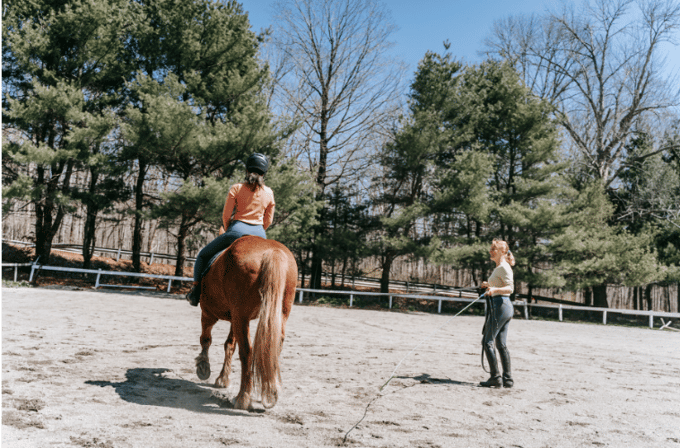
You could concentrate on your balance. Your position. Your seat. Your legs. Your rhythm. Maybe your instructor had you drop your reins, put your hands on your hips, stretch your arms out to the side or close your eyes for a few strides.
There was a reason those lessons could be so effective: they removed some of the complexity of riding so you could concentrate on yourself.
Interestingly, that’s one of the comparisons we hear from riders after they try Will-oh!, our horse-riding simulator.
“It reminds me of a lunge lesson.”
We think that’s a pretty good way to describe it.
What happens when the focus is entirely on the rider?
Riding is complicated.
While you’re thinking about your position, your horse may be speeding up, slowing down, falling in, looking at something outside the arena or simply deciding that maintaining that nice energetic trot wasn’t really part of the plan.
Will-oh! removes some of those variables.
Once you’ve asked her for walk, trot or canter, she maintains the gait and pace. You don’t have to keep your leg on to keep her moving.
That means we can say, “Forget about keeping the horse trotting for a minute. Let’s look at you.”
Suddenly, you have the freedom to concentrate on your seat, your balance, your legs, your rhythm or whatever else you’re trying to change.
But that doesn’t mean Will-oh! does the riding for you.
Horses are wonderfully helpful creatures. Sometimes too helpful.
Ride the same pattern a few times and your horse may start doing it before you’ve actually asked. A well-trained horse may quietly compensate for an imperfect aid. A horse following another horse may make decisions about pace and direction without much input from you.
Will-oh! doesn’t.
She won’t anticipate the next movement because you’ve done it three times already. She doesn’t follow the horse in front. She doesn’t decide that you probably meant canter.
You have to ask.
Will-oh! makes it easier to focus on learning. She doesn’t necessarily make riding easier.
And then Will-oh! adds something a lunge lesson couldn’t: data
Once a rider has spent about 10–15 minutes getting comfortable with Will-oh! and learning how she responds to the leg and rein sensors, we usually complete a short rider assessment.
This is often the part people are most curious about — and sometimes a little nervous about.
The rider doesn’t have to do anything special for the assessment. In fact, we don’t want you to.
Just relax and ride as you normally would.
Over approximately two minutes, Will-oh! takes you through 30 seconds each of walk, trot, left canter and right canter while her sensors capture information about your riding.
We can see your balance from left to right and front to back, how and where you’re making contact with the saddle, your rein pressure and what your legs are doing.
And then we look at it together.
“Oh! I’m not as bad as I thought.”
This may be one of our favourite reactions.
Some riders arrive nervous that Will-oh! is somehow going to expose everything that’s “wrong” with their riding.
That’s not really what happens.
More often, riders look at their assessment and say something like:
“Oh! I’m not as bad as I thought.”
Or:
“I sort of knew I did that.”
Usually we’re not uncovering some enormous riding problem. We’re finding little things.
Maybe you’re consistently carrying slightly more weight to one side. Maybe you’re sitting a little forward. Perhaps one leg is quieter than the other. Maybe you’re holding more rein pressure on one side.
Sometimes simply seeing it and becoming aware of it makes a remarkable difference.
Other times we’ll experiment with a small change — a different way of finding centre, releasing some tension or changing a position — and immediately see and feel what happens.
And every once in a while, there’s a wonderful lightbulb moment:
“Ohhh…is THAT why my horse always does that?”
Your body usually has a story, too
One of the things we find particularly interesting is how often the information from Will-oh! connects to something happening in the rider’s own body.
As a rider goes through the assessment, we’re also watching.
We might notice tension, stiffness, a slight rotation or that one side seems to move differently from the other.
And when we mention it, we often hear:
“I injured that hip years ago.”
“That side is always tighter.”
“I’ve always struggled with that leg.”
Suddenly, something the rider has felt for years has become visible.
That’s not about judging someone’s position or trying to create a picture-perfect rider. It’s information we can use to help the rider find a position that is more balanced, effective and comfortable.
Then we get to experiment
The assessment isn’t the lesson. It’s really the starting point.
For the remainder of the session, we can work on whatever is most useful to that rider.
Sometimes they arrive with a very specific goal:
I want to feel more comfortable in canter.
I’ve never really figured out rising trot.
I struggle with transitions.
I want to understand what my outside rein is supposed to be doing.
Other times, the assessment gives us our starting point.
We can work in training mode with real-time feedback from Will-oh!’s sensors. We can repeat something several times. Make an adjustment. Try it again. Feel the difference. Look at the feedback.
And because Will-oh! is a simulator, we can concentrate on the rider without asking a real horse to repeat the exercise over and over while we’re figuring it out.
That’s an important part of this for us.
The goal isn’t to replace riding your horse.
It’s to help you become a better rider for your horse.
But don’t mistake “simulator” for “easy”
Will-oh! feels remarkably like riding a horse — and she expects you to ride her.
Once we start asking for more, she can become quite demanding.
Take her out on a virtual hack and now you need to steer. She will quite happily walk into a fence — or apparently a church — if you don’t tell her otherwise!
Try lateral work and the challenge increases again. Will-oh! can perform movements including leg yield, shoulder-in, half-pass, piaffe and passage, but she requires the correct combination of seat, leg and rein aids.
She won’t fill in the blanks for you.
That makes these movements useful for far more than advanced dressage riders. Holding and coordinating the appropriate aids can reveal differences in strength, coordination or flexibility from one side of the body to the other.
Sometimes we explore that during a first session. Sometimes it becomes something to work on in future sessions.
There’s always more to discover.
Learn it on Will-oh!. Take it back to your horse.
And this is where we come back to the old-fashioned lunge lesson.
The point of a lunge lesson was never to become really good at riding on a lunge line.
It was to isolate something, understand it and develop a better feel — and then take that learning back into your regular riding.
That’s exactly how we think about Will-oh!.
She’s a tool.
A remarkably sophisticated one, certainly. But the technology isn’t really the point.
The point is what happens the next time you get on your own horse.
Maybe you recognize that you’re shifting to the left.
Maybe you find your centre more quickly.
Maybe your leg becomes quieter.
Maybe your transition improves because your aid is clearer.
Or maybe something your horse has been doing for months suddenly makes a little more sense.
Sometimes becoming a better rider starts by temporarily making riding simpler.
Traditional wisdom. Modern technology. The goal hasn’t changed: helping riders become better partners for their horses.
Curious what Will-oh! might show you?
Will-oh! is our horse-riding simulator at Willow & Withers Stables in Sheffield Mills, Nova Scotia.
A first individual session gives you time to get comfortable with Will-oh!, experience the rider assessment and then work with a coach on whatever you would most like to explore.
You don’t need to be an advanced rider. You don’t need to ride dressage. And you definitely don’t need to arrive with perfect position.
You just need to be curious about your riding.
Come ride. Learn. Experiment. And take what you discover back to your horse.
Learn more about Will-oh! here https://willowandwithers.ca/horse-simulator or book here
https://book.squareup.com/appointments/d8q2dvgl35ea69/location/L7P6AGKPFVVAW/services