Explore how teaching riders to learn independently enhances their equestrian skills, fostering awareness and confidence beyond lessons.
Reflections on rider ownership, independence and what I learned by becoming the student again.
“Get out of my head. My body knows.”
That was one of my biggest takeaways from my recent training in the UK, and it's a thought I've been returning to ever since.
In late September, I travelled to Stafford, England, to participate in the Pelvis Training offered through Train Your Seat Equestrian Training. My goal was to deepen my understanding of rider biomechanics and bring new ideas, exercises and approaches back to Will-oh!, our equestrian simulator at Willow & Withers Stables.
I certainly came home with plenty of new knowledge and practical tools, but what has stayed with me most isn't a particular exercise or technique. It's a renewed appreciation for how riders learn, and perhaps more importantly, how we can help them take greater ownership of their own development. 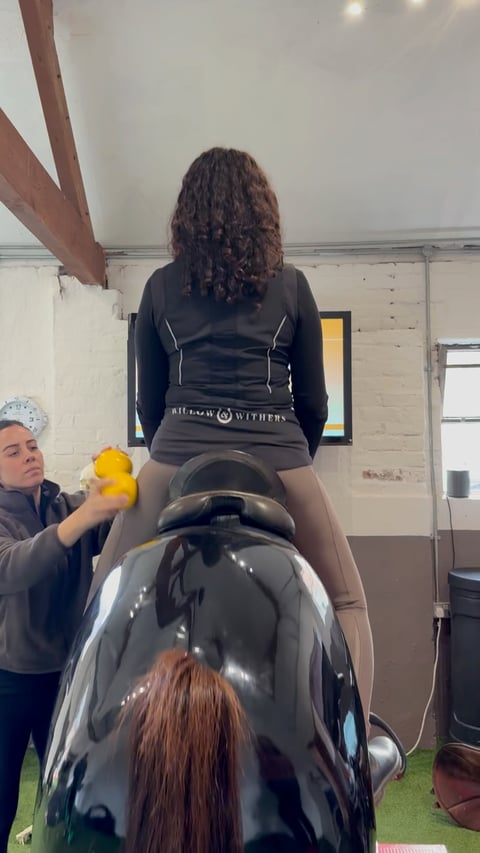
Sometimes we need to feel it before we understand it
One exercise in particular has stayed with me. We were exploring movement in canter, using a band around the waist to help us better understand and experience the movement of the pelvis.
I've ridden for years, and I have a reasonable understanding of the mechanics of canter. I could explain what should be happening, but this exercise gave me something different. It helped me feel the movement in a way that made sense to my body, creating a greater sense of security and understanding.
What struck me was that I hadn't been given a better set of instructions. I'd been given an opportunity to experience something for myself, and that experience changed my understanding.
As riders, we're accustomed to receiving instructions. Sit taller, relax your hips, keep your leg still, follow the movement, don't grip. These are all familiar cues, and they certainly have their place, but they assume we understand what the desired movement is supposed to feel like.
What happens when we don't? We might try harder, make a temporary adjustment or even achieve the desired result without really understanding how we got there. The instructor sees an improvement, but has the rider actually learned something they can reproduce independently?
That's the question I've been thinking about.
The value of experimentation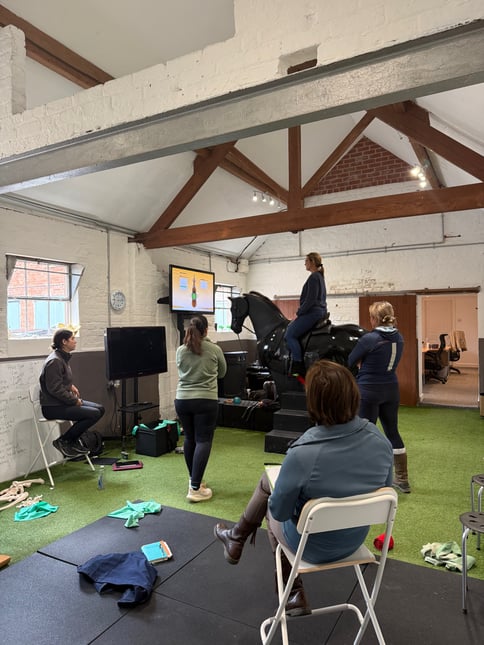
Another aspect of the training that really resonated with me was the use of experimentation. Rather than always trying to correct a movement immediately, we were sometimes encouraged to exaggerate it.
What happens when you deliberately grip? What changes in your balance or your ability to move? What happens when you release that tension? Can you recognize the difference?
It's a fascinating approach because it shifts the focus away from simply performing a movement correctly and towards understanding what's happening in your body.
And importantly, it gives the rider a role in finding the solution.
Sometimes we discover that something we thought was helping us is actually making the movement more difficult. Other times, an exercise or a different way of thinking about a movement creates an immediate connection. And sometimes an approach doesn't work particularly well for us, which is useful information too.
Not every exercise will resonate with every rider. We have different bodies, experiences, habits and ways of learning. Having a variety of approaches allows us to experiment, but the real value comes from encouraging the rider to notice and evaluate the results.
Did that feel easier? More balanced? More secure? Could you feel a difference? Would you recognize that feeling again?
These are questions that help turn an exercise into learning.
Are we creating better riders or more dependent riders?
This brings me to something I've been thinking about quite a bit: the difference between helping someone ride better during a lesson and helping them become a more independent rider.
Most of us have experienced a lesson where everything seems to come together. The instructor gives us a series of well-timed corrections, we make the adjustments and suddenly things feel fantastic. It's a wonderful feeling, but what happens when we're riding on our own the next day?
Can we recognize when we're losing our balance or creating tension? Do we understand what helped us achieve that better movement? Can we experiment with an adjustment and evaluate whether it's working?
Or are we waiting for someone on the ground to tell us what to do?
I don't think this is about reducing the importance of good coaching. Quite the opposite. I think it challenges us as coaches to consider what success really looks like.
If our goal is simply to improve what happens during the lesson, we might focus primarily on correcting what we see. But if our goal is to develop a rider who can continue learning independently, we need to do more than provide instructions. We need to help riders develop awareness, curiosity and confidence in their own ability to make decisions.
There's a concept in learning called self-efficacy, which refers to our belief in our ability to accomplish something. In riding, that belief can be particularly important. Riders who trust their ability to recognize problems, explore solutions and make adjustments may be better equipped to work through challenges without losing confidence.
And that confidence doesn't have to come from getting everything right. It can come from knowing what to do when something doesn't feel right.
Giving riders time and space to learn
Another valuable reminder from my training was that learning takes time, and we don't all process information in the same way.
As instructors, it's tempting to keep offering information, particularly when we can see something that needs correcting. But there are times when another instruction is the last thing a rider needs. They may simply need a moment to process what they're feeling, experiment with a movement or make a connection for themselves.
A question can sometimes be more powerful than a correction.
Instead of immediately telling someone what to change, what if we asked what they noticed? Or invited them to try something different and describe the result?
This doesn't mean leaving riders to figure everything out on their own. Good coaching still involves observation, guidance, expertise and appropriate feedback. But it also means knowing when to step back and give the rider an opportunity to participate actively in the learning process.
And perhaps that's one of the most important things we can do: help riders learn to trust their own observations rather than relying entirely on ours.
Bringing this approach back to Will-oh!
One of the things I appreciate most about Will-oh! is that the simulator gives us an unusual opportunity to focus on the rider without the added responsibility of managing a live horse.
We can slow things down, repeat a movement, explore different sensations and pay attention to things that might be difficult to isolate during a regular riding lesson. We can use imagery, changes in movement or tools such as Franklin balls and bands to help riders explore balance, coordination, tension and mobility.
But increasingly, I'm thinking less about the exercises themselves and more about what the rider takes away from them.
I'm drawn to a simple learning process:
Notice → Explore → Recheck → Own it.
We begin by helping the rider recognize what's happening. We establish a starting point, then introduce an exercise or experiment and see what changes. We check again, comparing the experience with where we started, and encourage the rider to identify what was useful.
The final step is perhaps the most important. How can the rider take ownership of that discovery? Can they recognize the feeling again? Do they understand what changed? Can they apply that knowledge when they're back on their own horse?
The goal isn't to make riders dependent on a simulator, a particular piece of equipment or even a coach. It's to give them experiences and tools that help them become more aware, adaptable and independent in their riding.
And while Will-oh! provides an excellent environment for this kind of exploration, the philosophy certainly isn't limited to simulator training. It's an approach I believe has value in all sorts of riding lessons, regardless of discipline or experience level.
Becoming a better rider by becoming a better learner
I went to the UK expecting to learn more about how the rider's body works, particularly the pelvis and its role in absorbing and influencing the horse's movement. I certainly did, and I'm looking forward to incorporating more of what I learned into our sessions at Will-oh!
But I also came home with a renewed appreciation for the learning process itself.
Being the student again reminded me how valuable it is to have opportunities to explore, ask questions, make mistakes and experience those moments when something suddenly makes sense. It also reminded me that understanding a concept intellectually isn't always the same as being able to feel or apply it.
As riders, we're always going to benefit from good instruction, thoughtful feedback and experienced eyes on the ground. But I wonder if we sometimes underestimate how much more we could achieve by making riders more active participants in their own learning.
Perhaps one of the best measures of successful coaching isn't simply how well someone rides at the end of a lesson, but how much better equipped they are to continue learning when the lesson is over.
After all, the goal shouldn't be to create riders who always need someone to tell them what to do. It should be to help them develop the awareness, confidence and understanding to figure more of it out for themselves.
Melanie Taljaard is the owner of Will-oh! at Willow & Withers Stables in Sheffield Mills, Nova Scotia. Will-oh! offers a unique environment for riders of different disciplines and experience levels to explore their movement, develop body awareness and build confidence through coached equestrian simulator sessions.